
Third-party logistics management (3PL) has revolutionized supply chain operations, offering businesses a strategic advantage in today’s competitive landscape. By outsourcing non-core logistics functions, companies can focus on their core competencies while leveraging the expertise and resources of specialized 3PL providers. This approach offers significant potential for cost reduction, improved efficiency, and enhanced supply chain visibility, ultimately contributing to increased profitability and market competitiveness.
This guide explores the multifaceted world of 3PL, delving into key aspects such as provider selection, contract negotiation, technology integration, risk management, and the impact on overall supply chain efficiency. We’ll examine the advantages and disadvantages, providing a balanced perspective to aid in informed decision-making. The complexities of integrating liquidity management with effective logistics will also be addressed, highlighting the crucial interplay between financial stability and efficient operations.
Technology in 3PL
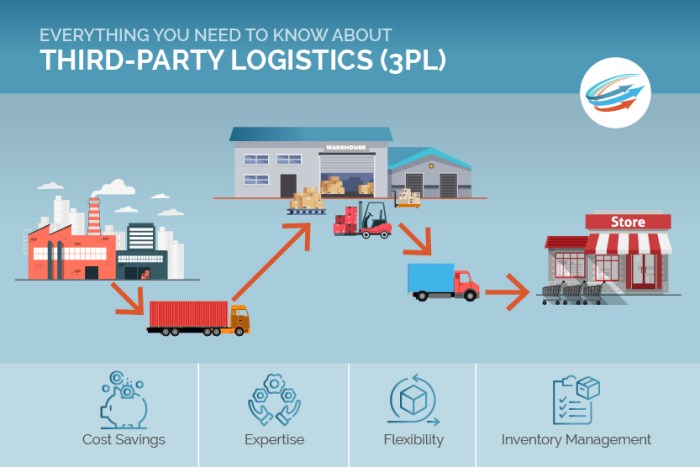
Technology plays a pivotal role in modernizing and optimizing third-party logistics (3PL) operations. The efficient management of complex supply chains demands sophisticated tools and systems that streamline processes, enhance visibility, and improve overall performance. Without technological integration, 3PL providers would struggle to meet the demands of today’s fast-paced and data-driven business environment.The effective use of technology allows 3PL providers to offer enhanced services, improve cost efficiency, and provide clients with real-time data and analytics, fostering stronger partnerships and improved decision-making.
This ultimately leads to a more agile and responsive supply chain, better equipped to handle unexpected disruptions and market fluctuations.
Warehouse Management Systems (WMS)
Warehouse Management Systems (WMS) are software applications designed to support and optimize the day-to-day operations within a warehouse. These systems manage and track inventory, direct warehouse staff, optimize storage space, and streamline the receiving, picking, packing, and shipping processes. A well-implemented WMS significantly reduces errors, minimizes labor costs, and improves overall warehouse efficiency. For example, a WMS might automatically direct a picker to the optimal location for a specific item, minimizing travel time and increasing order fulfillment speed.
Furthermore, sophisticated WMS can integrate with other systems, such as transportation management systems (TMS), providing a seamless flow of information throughout the entire supply chain.
Transportation Management Systems (TMS)
Transportation Management Systems (TMS) are software solutions that manage and optimize the transportation of goods. These systems handle functions such as route planning, carrier selection, shipment tracking, and freight cost management. A TMS can significantly reduce transportation costs by optimizing routes, consolidating shipments, and negotiating favorable rates with carriers. For instance, a TMS might analyze various transportation options – including different carriers, modes of transport, and routes – to identify the most cost-effective and efficient solution for a particular shipment.
Real-time tracking capabilities also allow for proactive issue resolution and improved delivery predictability.
Radio-Frequency Identification (RFID)
Radio-Frequency Identification (RFID) technology uses electronic tags and readers to identify and track items throughout the supply chain. RFID tags contain unique identifiers that can be read wirelessly by RFID readers. This technology provides real-time visibility into inventory levels, location, and movement. In a 3PL context, RFID can significantly improve inventory accuracy, reduce stockouts, and streamline warehouse operations.
For example, RFID tags on pallets can be scanned as they move through the warehouse, providing continuous updates on their location and status. This allows for immediate identification of misplaced or lost items, reducing search time and improving overall efficiency.
Integrating 3PL Technology with Existing Systems
Integrating 3PL technology with a company’s existing Enterprise Resource Planning (ERP) systems and other internal platforms is crucial for maximizing efficiency and data transparency. This integration enables seamless data exchange, eliminating manual data entry and reducing the risk of errors. Real-time data visibility across the entire supply chain allows for better decision-making, improved forecasting, and proactive problem-solving. For example, integration with an ERP system allows for real-time updates on inventory levels, enabling companies to optimize production schedules and avoid stockouts.
The resulting enhanced collaboration and communication between the 3PL provider and the client fosters stronger partnerships and mutual success.
Advantages and Disadvantages of 3PL Technologies
The implementation of 3PL technologies offers significant benefits, but it also presents certain challenges. Careful consideration of these factors is crucial for successful adoption.
- WMS Advantages: Improved inventory accuracy, reduced labor costs, increased efficiency, optimized warehouse space, better order fulfillment.
- WMS Disadvantages: High initial investment costs, complexity of implementation, potential for system downtime, need for specialized training.
- TMS Advantages: Reduced transportation costs, improved route optimization, enhanced shipment tracking, better carrier management.
- TMS Disadvantages: High initial investment costs, integration challenges with existing systems, dependence on reliable internet connectivity, potential for data security risks.
- RFID Advantages: Real-time inventory visibility, improved accuracy, reduced stockouts, enhanced security, streamlined warehouse operations.
- RFID Disadvantages: High initial investment costs, potential for signal interference, need for specialized readers and tags, data security concerns.
Future Trends in 3PL
The 3PL industry is undergoing a rapid transformation, driven by technological advancements and evolving customer expectations. Increased demand for efficiency, transparency, and sustainability is pushing logistics providers to adopt innovative solutions and adapt their business models to remain competitive. This section will explore key emerging trends shaping the future of 3PL, their impact on businesses, and examples of innovative solutions already being implemented.
Automation and Robotics in 3PL Warehousing
Automation is revolutionizing warehouse operations, increasing efficiency and reducing labor costs. Robotic process automation (RPA) handles repetitive tasks like picking, packing, and sorting, while automated guided vehicles (AGVs) and autonomous mobile robots (AMRs) optimize material handling within the warehouse. The integration of warehouse management systems (WMS) with these technologies creates a highly efficient and data-driven environment. For example, Amazon’s extensive use of robotics in its fulfillment centers demonstrates the significant productivity gains achievable through automation.
This increased efficiency translates to faster order fulfillment, reduced errors, and improved overall operational costs for businesses utilizing these 3PL services.
Artificial Intelligence (AI) and Machine Learning (ML) in 3PL
AI and ML are transforming various aspects of 3PL, from predictive analytics to route optimization. AI-powered systems can analyze vast datasets to forecast demand, optimize inventory levels, and predict potential disruptions in the supply chain. Machine learning algorithms enhance route planning, leading to reduced fuel consumption and delivery times. For instance, companies like UPS utilize AI-powered route optimization software to navigate complex delivery networks efficiently.
This results in cost savings for 3PL providers and more reliable, cost-effective delivery services for their clients.
Sustainability Initiatives in 3PL
Growing environmental concerns are driving the adoption of sustainable practices within the 3PL sector. Companies are increasingly focusing on reducing their carbon footprint through initiatives such as optimizing transportation routes, utilizing alternative fuels, and adopting eco-friendly packaging materials. The implementation of green logistics strategies not only benefits the environment but also enhances a company’s brand image and attracts environmentally conscious customers.
Companies like DHL have set ambitious sustainability goals, investing heavily in electric vehicles and carbon offsetting programs. This commitment to sustainability is becoming a key differentiator in the 3PL market, influencing customer choices and attracting environmentally conscious businesses.
Innovative 3PL Solutions
Several innovative solutions are emerging to meet the evolving needs of businesses. These include the use of blockchain technology for enhanced supply chain transparency and traceability, the implementation of Internet of Things (IoT) devices for real-time tracking and monitoring of goods, and the development of advanced analytics dashboards providing real-time visibility into supply chain performance. For example, the use of blockchain allows for secure and transparent tracking of goods throughout the entire supply chain, reducing the risk of counterfeiting and improving accountability.
The adoption of these innovative solutions enhances supply chain visibility, improves efficiency, and reduces operational risks for businesses relying on 3PL services.
Timeline for 3PL Evolution (Next 5-10 Years)
The next 5-10 years will witness a significant shift in the 3PL landscape. We can expect a substantial increase in automation and AI adoption across all aspects of logistics, from warehousing to transportation. Sustainability initiatives will become increasingly prevalent, with a greater emphasis on reducing carbon emissions and adopting eco-friendly practices. The integration of emerging technologies, such as blockchain and IoT, will enhance supply chain transparency and efficiency.
By 2025, we anticipate widespread adoption of automated guided vehicles (AGVs) and autonomous mobile robots (AMRs) in warehouses. By 2030, AI-powered predictive analytics will be commonplace, enabling proactive risk management and optimized resource allocation. The widespread adoption of sustainable practices, including electric vehicles and carbon offsetting programs, will be a significant trend throughout this period. This evolution will lead to a more efficient, transparent, and sustainable logistics industry, benefiting both 3PL providers and their clients.
Successfully navigating the intricacies of third-party logistics management requires a strategic approach, encompassing careful provider selection, robust contract negotiation, and continuous performance monitoring. By understanding the potential benefits and risks, and proactively implementing effective risk mitigation strategies, businesses can harness the power of 3PL to optimize their supply chains, reduce costs, and gain a competitive edge. The future of 3PL is undeniably shaped by technological advancements and evolving market demands, promising even greater efficiency and innovation in the years to come.
Understanding these trends is crucial for staying ahead in this dynamic industry.
Popular Questions
What are the common types of 3PL services?
Common 3PL services include warehousing, transportation (trucking, air, sea), inventory management, order fulfillment, and freight forwarding.
How do I choose the right Key Performance Indicators (KPIs) to measure my 3PL provider’s performance?
KPIs should align with your business goals. Consider metrics like on-time delivery, order accuracy, inventory turnover, and cost per unit.
What are some potential risks associated with using a 3PL?
Potential risks include loss or damage of goods, security breaches, lack of control over operations, and potential disruptions to the supply chain due to provider issues.
What is the role of technology in modern 3PL?
Technology plays a crucial role, improving visibility, automation, and efficiency through systems like Warehouse Management Systems (WMS), Transportation Management Systems (TMS), and Radio Frequency Identification (RFID).
How can I ensure a smooth transition to a 3PL provider?
A smooth transition requires thorough planning, open communication, and a well-defined implementation plan. Data migration and staff training are also critical aspects.


