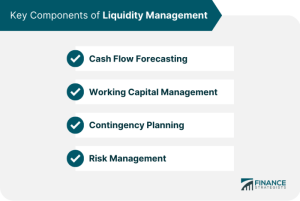
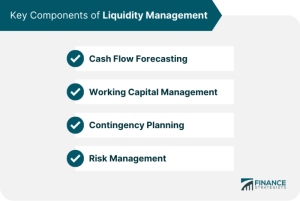
Effective liquidity management and working capital optimization are cornerstones of a thriving business. Understanding how to balance short-term and long-term financial needs, and efficiently managing assets and liabilities, is crucial for profitability and sustainable growth. This exploration delves into the key metrics, strategies, and external factors influencing a company’s financial health, ultimately guiding businesses toward robust financial management.
This analysis examines the intricate relationship between liquidity, the ability to meet immediate financial obligations, and working capital, the difference between current assets and current liabilities. We will explore various techniques for optimizing working capital, such as inventory management, accounts receivable management, and accounts payable management, while considering the impact of economic cycles, interest rate fluctuations, and supply chain dynamics.
Case studies of successful companies will illustrate the practical application of these principles.
Defining Liquidity Management and Working Capital
Effective liquidity management and efficient working capital are crucial for a company’s financial health and sustainable growth. These concepts, while interconnected, represent distinct aspects of a business’s financial operations. Understanding their nuances is vital for making sound financial decisions.Liquidity management focuses on ensuring a company has sufficient readily available cash or assets that can be quickly converted into cash to meet its short-term obligations.
Working capital, on the other hand, represents the difference between a company’s current assets (like cash, accounts receivable, and inventory) and its current liabilities (like accounts payable, short-term debt, and accrued expenses). A positive working capital balance indicates the company has enough liquid assets to cover its immediate debts.
Short-Term and Long-Term Liquidity Needs
Short-term liquidity needs typically involve meeting immediate operational expenses such as payroll, supplier payments, and rent. These needs are usually funded through readily available cash, short-term loans, or the quick sale of liquid assets. Long-term liquidity needs, conversely, relate to financing major capital expenditures, such as purchasing new equipment or expanding facilities. These needs often involve long-term debt financing, equity financing, or the sale of non-liquid assets.
The key difference lies in the timeframe – short-term needs are immediate and urgent, while long-term needs can be planned and addressed over a longer period. For example, a company might use a line of credit to cover unexpected short-term expenses, while issuing bonds to finance a new factory.
Working Capital’s Impact on Profitability
Efficient working capital management directly influences a company’s profitability. Optimal working capital allows a company to take advantage of early payment discounts from suppliers, invest in growth opportunities, and maintain a healthy financial position. Conversely, insufficient working capital can lead to missed payment deadlines, damage to supplier relationships, lost sales opportunities due to inventory shortages, and even potential bankruptcy.
For instance, a company with excessive inventory ties up capital that could be used more profitably elsewhere, reducing overall return on investment. Conversely, a company with insufficient inventory might lose sales due to stockouts. The ideal working capital level is a balance between sufficient funds to support operations and avoiding excessive tying up of capital.
A Simple Model Illustrating the Relationship Between Liquidity and Working Capital
A simplified model can illustrate the relationship: Imagine a seesaw. On one side is “Liquidity,” represented by readily available cash and quickly convertible assets. On the other side is “Working Capital Needs,” encompassing current liabilities and the necessary level of current assets to support operations. A balanced seesaw represents a healthy financial state where sufficient liquidity exists to cover working capital needs.
If the “Working Capital Needs” side is heavier (excessive liabilities or insufficient assets), the seesaw tilts, indicating potential liquidity problems. Conversely, if the “Liquidity” side is excessively heavy (too much cash), the company might be missing opportunities for profitable investment. The goal is to maintain a balanced seesaw, ensuring adequate liquidity to meet immediate obligations while efficiently managing working capital to maximize profitability.
Key Metrics for Assessing Liquidity and Working Capital
Effective liquidity and working capital management are crucial for a company’s financial health and sustainability. Understanding key metrics allows businesses to monitor their short-term financial position, identify potential problems, and make informed decisions to optimize cash flow and operational efficiency. This section will delve into the essential metrics used to assess both liquidity and working capital efficiency.
Key Liquidity Metrics
Assessing liquidity requires a multifaceted approach, employing several metrics to gain a comprehensive understanding of a company’s ability to meet its short-term obligations. The following table Artikels five crucial metrics, their formulas, significance, and illustrative examples.
| Metric Name | Formula | Significance | Example |
|---|---|---|---|
| Current Ratio | Current Assets / Current Liabilities | Indicates the ability to pay short-term liabilities with current assets. A higher ratio generally suggests better liquidity. | A company with current assets of $100,000 and current liabilities of $50,000 has a current ratio of 2.0. |
| Quick Ratio (Acid-Test Ratio) | (Current Assets – Inventory) / Current Liabilities | A more conservative measure of liquidity, excluding inventory which may not be easily converted to cash. | Using the same example, if inventory is $20,000, the quick ratio is 1.6 ((100,000 – 20,000) / 50,000). |
| Cash Ratio | (Cash + Cash Equivalents) / Current Liabilities | The most stringent liquidity measure, focusing solely on the most liquid assets. | If cash and cash equivalents are $30,000, the cash ratio is 0.6 ($30,000 / $50,000). |
| Operating Cash Flow Ratio | Operating Cash Flow / Current Liabilities | Shows the ability to pay current liabilities from cash generated from operations. | If operating cash flow is $60,000, the operating cash flow ratio is 1.2 ($60,000 / $50,000). |
| Days Sales Outstanding (DSO) | (Accounts Receivable / Total Credit Sales)
|
Measures the average number of days it takes to collect payment from customers. A lower DSO indicates better efficiency in collections. Note: ‘Number of Days’ typically refers to a year (365 days) or a quarter (90 days), depending on the data used. | If accounts receivable are $25,000, total credit sales are $100,000, and the period is one year, DSO is 91.25 days ($25,000/$100,000 – 365). |
Working Capital Efficiency Ratios
Analyzing working capital efficiency provides insights into how effectively a company manages its current assets and liabilities to support its operations. Three common ratios used for this purpose are:The Working Capital Turnover Ratio, the Net Working Capital to Sales Ratio, and the Inventory Turnover Ratio. These ratios provide different perspectives on the effectiveness of working capital management.
For instance, a high working capital turnover ratio suggests efficient utilization of working capital to generate sales, while a low inventory turnover ratio may indicate potential issues with inventory management.
Limitations of Solely Using Financial Ratios for Assessing Liquidity
While financial ratios offer valuable insights into liquidity, relying solely on them can be misleading. These ratios are snapshots in time and don’t capture the dynamic nature of cash flows. Qualitative factors, such as the quality of accounts receivable, the reliability of supply chains, and overall economic conditions, significantly impact a company’s liquidity but are not reflected in these ratios.
Furthermore, manipulating accounting practices can artificially inflate liquidity ratios, masking underlying weaknesses. A comprehensive assessment requires considering both quantitative and qualitative factors.
Comparison of Liquidity Ratios Across Industries
The applicability of different liquidity ratios varies across industries. For example, a supermarket might have a lower quick ratio than a technology company because of its higher inventory turnover. Similarly, a manufacturing company with a long production cycle might have a lower current ratio than a service-based business due to higher levels of work-in-progress inventory. Therefore, industry benchmarks are essential when interpreting liquidity ratios.
Direct comparisons between companies in different industries should be made cautiously, focusing instead on trends within a specific industry.
Strategies for Effective Liquidity Management
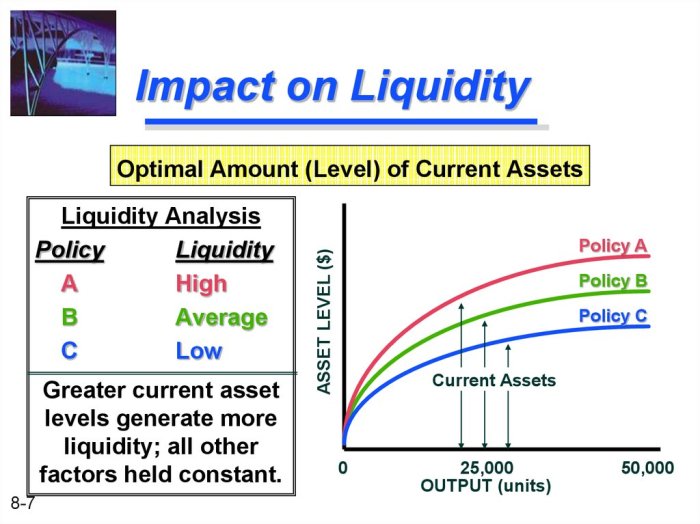
Effective liquidity management is crucial for a company’s financial health and stability. A well-defined strategy ensures sufficient funds are available to meet short-term obligations, allowing for smooth operations and preventing disruptions caused by cash flow shortages. This involves a proactive approach to forecasting cash needs and strategically managing both inflows and outflows.
Proactive Liquidity Management Techniques
Proactive liquidity management focuses on anticipating and preventing liquidity problems before they arise. This involves careful planning, robust forecasting, and the implementation of strategies to optimize cash flow. A key element is accurate sales forecasting, allowing for timely procurement of materials and efficient scheduling of production. Furthermore, proactive strategies involve building strong relationships with suppliers to negotiate favorable payment terms, such as extended credit periods.
Reactive Liquidity Management Techniques
Reactive liquidity management addresses liquidity issues that have already occurred. This often involves taking swift action to secure short-term funding or to reduce immediate cash outflows. For example, if sales unexpectedly decline, a company might implement cost-cutting measures, such as temporarily reducing non-essential expenses or delaying non-critical investments. Securing short-term loans or lines of credit can also provide immediate relief during unexpected cash flow shortfalls.
Negotiating with creditors to extend payment deadlines is another common reactive strategy.
Short-Term Financing Options for Liquidity Needs
Several financing options exist for managing short-term liquidity needs. The choice depends on factors such as the amount of funding required, the company’s creditworthiness, and the desired repayment terms.
- Bank Overdrafts: A bank overdraft allows a company to temporarily overdraw its checking account, providing immediate access to funds. It’s a flexible option, but typically carries a higher interest rate than other forms of financing.
- Short-Term Loans: These loans provide a fixed amount of funding for a specific period, with a predetermined repayment schedule. They offer more predictable costs than overdrafts but require a formal application process.
- Lines of Credit: A line of credit provides a pre-approved borrowing limit, allowing a company to borrow funds as needed up to the approved amount. This offers flexibility but may involve fees and interest charges on the outstanding balance.
Factoring and Invoice Discounting
Factoring and invoice discounting are both methods of financing receivables, offering a way to convert outstanding invoices into immediate cash.
- Factoring: A factoring company purchases a company’s accounts receivables at a discount. The factoring company then collects the payments directly from the customers. This provides immediate cash but at a cost, as the discount reflects the risk and administrative burden assumed by the factoring company. It’s particularly beneficial for companies with a large volume of receivables and a need for quick cash flow.
- Invoice Discounting: Similar to factoring, invoice discounting involves borrowing against outstanding invoices. However, unlike factoring, the company retains control over the collection process. This offers a lower cost than factoring but requires more administrative effort from the company itself. It’s a suitable option for companies that value maintaining customer relationships and control over collections.
Working Capital Management Techniques
Effective working capital management is crucial for a company’s financial health and operational efficiency. It involves strategically managing current assets and liabilities to ensure sufficient liquidity while optimizing resource utilization. This section delves into specific techniques for enhancing working capital management.
Efficient Inventory Management in Working Capital Optimization
Maintaining optimal inventory levels is paramount for working capital optimization. Excess inventory ties up significant capital, increasing storage costs and risking obsolescence. Conversely, insufficient inventory can lead to lost sales and production delays. Efficient inventory management minimizes these risks, freeing up capital for other business needs and improving profitability. This involves accurately forecasting demand, optimizing ordering quantities, and implementing efficient inventory tracking systems.
Reducing lead times through improved supplier relationships also plays a key role. For example, a company using a robust forecasting model might predict a 10% increase in demand for a particular product, allowing them to adjust their inventory levels proactively, avoiding stockouts and minimizing the need for emergency orders.
Implementing a Just-in-Time Inventory System
A Just-in-Time (JIT) inventory system aims to minimize inventory holding costs by receiving materials only when needed for production. Implementing a JIT system requires a carefully planned and coordinated approach.
- Needs Assessment and Planning: Thoroughly analyze production requirements and identify critical components. Establish strong relationships with reliable suppliers capable of meeting precise delivery schedules.
- Supplier Selection and Relationship Management: Choose suppliers with proven track records of on-time delivery and high-quality products. Foster close collaboration to ensure smooth communication and efficient material flow.
- Process Optimization: Streamline production processes to minimize waste and maximize efficiency. Implement lean manufacturing principles to reduce lead times and improve overall productivity.
- Inventory Tracking and Control: Utilize robust inventory management software to monitor stock levels in real-time. This enables proactive adjustments to ordering quantities based on actual production needs.
- Continuous Improvement: Regularly review and refine the JIT system to identify areas for improvement. Monitor key performance indicators (KPIs) such as inventory turnover rate and lead times to gauge effectiveness.
Effective Accounts Receivable Management Improves Cash Flow
Efficient accounts receivable management directly impacts a company’s cash flow. Prompt and accurate invoicing, coupled with effective collection strategies, ensures timely payments from customers. This minimizes the time money is tied up in outstanding invoices. Strategies include implementing automated invoicing systems, offering early payment discounts, and establishing clear credit policies. For instance, a company implementing an automated invoicing system might see a reduction in processing time from several days to just a few hours, speeding up the collection process and improving cash flow.
Furthermore, offering a 2% discount for payment within 10 days can incentivize faster payment from customers.
Best Practices for Managing Accounts Payable to Optimize Working Capital
Managing accounts payable effectively can significantly improve working capital. Negotiating favorable payment terms with suppliers, such as extended credit periods, allows for better cash flow management. Optimizing payment schedules to prioritize critical suppliers and leverage early payment discounts can further enhance working capital. Implementing a centralized system for tracking and processing invoices ensures accuracy and efficiency. For example, negotiating an extended payment term of 60 days instead of 30 days with a major supplier provides valuable breathing room for managing cash flow.
Similarly, taking advantage of a 1% discount for payment within 10 days can offer a significant cost savings, improving overall profitability.
Mastering liquidity management and working capital optimization is not merely about financial solvency; it’s about strategic positioning for long-term success. By implementing the strategies and techniques discussed – from proactive liquidity planning to efficient inventory management and robust accounts receivable processes – businesses can navigate economic uncertainties, enhance profitability, and achieve sustainable growth. The interplay between effective logistics and financial management further underscores the importance of a holistic approach to optimize resources and achieve competitive advantage.
Detailed FAQs
What is the difference between liquidity and solvency?
Liquidity refers to a company’s ability to meet its short-term obligations, while solvency refers to its ability to meet its long-term obligations.
How can a company improve its days sales outstanding (DSO)?
Improving DSO involves implementing stricter credit policies, offering early payment discounts, and employing efficient collection procedures.
What are some early warning signs of liquidity problems?
Early warning signs include increasing days payable outstanding (DPO), declining cash flow, and difficulty obtaining credit.
How does inflation impact working capital management?
Inflation increases the cost of goods sold and can lead to higher inventory costs, impacting working capital requirements. Businesses need to adjust pricing and inventory strategies accordingly.