Effective liquidity management is the cornerstone of a stable and resilient financial institution. This critical function ensures that banks and other financial entities can meet their short-term obligations, withstand unexpected shocks, and maintain operational efficiency. Understanding the intricacies of liquidity risk, the strategies for its mitigation, and the role of technology in modern liquidity management is crucial for navigating the complex landscape of the financial world.
This exploration delves into the core principles of liquidity management, examining various risk assessment tools, proactive and reactive strategies, and the impact of regulatory frameworks. We’ll analyze the evolving role of technology, from advanced analytics to automated systems, and showcase real-world case studies illustrating both successful navigation of crises and the consequences of poor liquidity management. Finally, we’ll explore the crucial relationship between liquidity risk and interest rate risk, highlighting strategies for managing both simultaneously.
Liquidity Management Strategies and Tools
Effective liquidity management is crucial for the stability and solvency of financial institutions. A robust strategy ensures that banks can meet their obligations as they fall due, even during periods of unexpected stress. This involves a combination of proactive planning, reactive responses, and a deep understanding of the regulatory environment.
The Role of Regulatory Frameworks in Shaping Liquidity Management Practices
Regulatory frameworks play a significant role in shaping liquidity management practices within financial institutions. These frameworks, such as Basel III, aim to enhance the resilience of the banking sector by setting minimum liquidity standards and promoting proactive risk management. Regulations often mandate the maintenance of specific liquidity coverage ratios (LCR) and net stable funding ratios (NSFR), requiring banks to hold sufficient high-quality liquid assets to cover potential outflows over a specified period.
Compliance with these regulations necessitates a comprehensive liquidity risk management framework, including robust forecasting models, stress testing, and regular reporting to supervisory authorities. Failure to meet these regulatory requirements can result in significant penalties and reputational damage. The ongoing evolution of these regulatory frameworks reflects a continuous effort to improve the stability and safety of the global financial system.
Proactive Liquidity Management Strategies Employed by Banks
Proactive liquidity management involves anticipating potential liquidity needs and taking steps to mitigate risks before they materialize. Several key strategies are employed. Diversification of funding sources reduces reliance on any single source and mitigates the risk of funding disruptions. Maintaining strong relationships with correspondent banks and other financial institutions provides access to additional liquidity sources when needed.
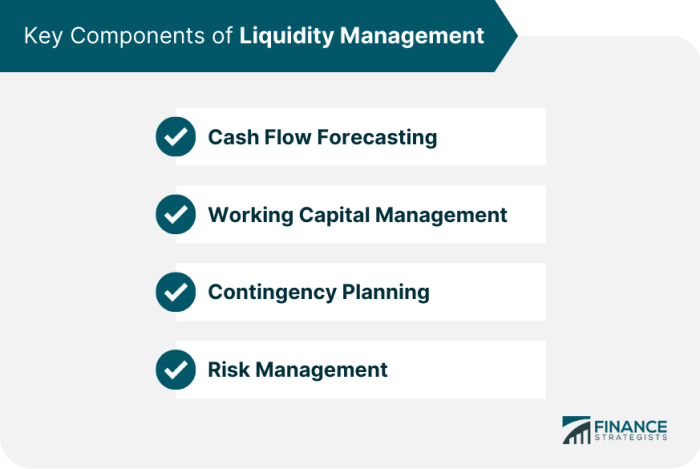
Careful monitoring of liquidity positions, utilizing sophisticated forecasting models, allows for early identification of potential shortfalls. Active asset-liability management (ALM) ensures that the bank’s assets and liabilities are appropriately matched in terms of maturity and liquidity. This involves carefully managing the timing and amounts of both inflows and outflows of funds. Furthermore, proactive strategies include developing contingency plans to address potential liquidity shocks and regularly stress-testing the bank’s liquidity position under various adverse scenarios.
Reactive Liquidity Management Techniques Used During Times of Stress
During periods of financial stress, reactive liquidity management techniques become crucial. Banks may need to quickly access additional liquidity to meet unexpected outflows. This can involve drawing down on pre-arranged credit lines with central banks or other financial institutions. Selling liquid assets, such as government securities, provides immediate cash inflows. Reducing lending activities to conserve liquidity is another option, although this may impact profitability and customer relationships.
Negotiating with creditors to extend repayment terms can provide temporary relief from immediate payment obligations. In extreme cases, banks may need to seek government assistance or engage in mergers or acquisitions to improve their liquidity position. The effectiveness of these reactive measures depends heavily on the severity of the stress and the bank’s preparedness.
Hypothetical Liquidity Management Plan for a Medium-Sized Commercial Bank
A hypothetical liquidity management plan for a medium-sized commercial bank would incorporate elements of both proactive and reactive strategies. The plan would begin with a comprehensive liquidity risk assessment, identifying potential sources of liquidity risk and quantifying their impact. This assessment would inform the development of liquidity risk limits and thresholds. The bank would maintain a diversified funding profile, including deposits, wholesale funding, and access to central bank liquidity facilities.
Regular liquidity stress testing would simulate various adverse scenarios, such as a sudden deposit outflow or a credit crunch. The plan would detail specific actions to be taken under different stress scenarios, including the sale of liquid assets, reduction of lending, and the utilization of contingency funding sources. The plan would also include a robust reporting and monitoring framework, ensuring that liquidity risk is continuously monitored and managed.
Regular reviews and updates of the plan would ensure its continued relevance and effectiveness in a changing environment. The plan would be regularly reviewed and updated to reflect changes in the bank’s operations, the regulatory environment, and the overall economic climate. Finally, clear communication and coordination among different departments within the bank would be essential for effective execution of the plan during periods of stress.
The Role of Technology in Liquidity Management
Technology has revolutionized liquidity management in financial institutions, enabling more efficient, accurate, and proactive risk management. The increasing complexity of financial markets and regulatory requirements necessitates the adoption of advanced technological solutions to ensure the stability and solvency of these institutions. This section will explore the key technological advancements and their impact on liquidity risk assessment and management.
Key Technological Advancements Impacting Liquidity Management
Several technological advancements have significantly improved liquidity management capabilities. These include advancements in data analytics, artificial intelligence (AI), machine learning (ML), and cloud computing. These technologies work in concert to provide a more holistic and dynamic view of a financial institution’s liquidity position. For instance, the ability to process and analyze vast datasets in real-time allows for quicker identification of emerging liquidity risks.
Advanced Analytics for Improved Liquidity Risk Assessment
Advanced analytics plays a crucial role in enhancing liquidity risk assessment. By leveraging techniques such as predictive modeling and scenario analysis, institutions can better anticipate potential liquidity shortfalls. For example, machine learning algorithms can analyze historical data, market trends, and economic indicators to predict future liquidity needs with greater accuracy than traditional methods. This allows for proactive adjustments to liquidity buffers and strategies, minimizing the impact of unexpected events.
Furthermore, stress testing models are enhanced by advanced analytics, enabling institutions to assess their resilience to various extreme scenarios, such as a sudden market downturn or a large-scale withdrawal of deposits.
Benefits and Challenges of Implementing Automated Liquidity Management Systems
Automated liquidity management systems offer significant benefits, including increased efficiency, reduced operational costs, and improved decision-making. Automation streamlines processes such as cash forecasting, collateral management, and regulatory reporting. However, implementing these systems presents challenges. The initial investment can be substantial, requiring significant upfront costs for software, hardware, and training. Furthermore, integrating new systems with existing legacy systems can be complex and time-consuming.
Data security and regulatory compliance are also critical considerations. Successful implementation requires careful planning, robust testing, and ongoing monitoring. For example, a large multinational bank might experience significant cost savings through automation, but needs to allocate significant resources upfront to ensure a smooth transition and address potential integration challenges.
Traditional versus Technology-Driven Approaches to Liquidity Management
Traditional approaches to liquidity management often rely heavily on manual processes and simpler models. These methods are often less efficient and less responsive to rapidly changing market conditions. Technology-driven approaches, in contrast, leverage advanced analytics, AI, and automation to provide a more dynamic and proactive view of liquidity risk. They enable faster identification of potential issues, more accurate forecasting, and more effective mitigation strategies.
While traditional methods may suffice for smaller institutions with simpler operations, larger and more complex institutions require technology-driven solutions to effectively manage their liquidity risk in today’s dynamic market environment. The comparative effectiveness is evident in the speed and accuracy of risk assessment and the proactive nature of liquidity management strategies implemented.
Case Studies of Effective Liquidity Management
Effective liquidity management is crucial for the survival and success of any financial institution. A robust liquidity risk management framework, encompassing proactive strategies and the utilization of appropriate tools, is essential to navigate both predictable and unpredictable market fluctuations. Analyzing case studies of both successful navigation of crises and instances of poor management provides invaluable insights for improving practices.
A Successful Navigation of a Liquidity Crisis: The Case of Northern Rock
While seemingly a case study of failure, Northern Rock’s 2007 liquidity crisis offers a valuable lesson in the importance of diversification and robust contingency planning. The bank’s heavy reliance on short-term wholesale funding proved disastrous when the interbank lending market froze during the subprime mortgage crisis. However, the subsequent government intervention and the eventual sale to Virgin Money illustrate the importance of swift and decisive action in mitigating the impact of a liquidity crisis.
The crisis exposed the dangers of over-reliance on a single funding source and highlighted the need for stress testing under various market scenarios. While the initial response was inadequate, the ultimate resolution demonstrated the capacity of regulatory bodies and the market to resolve even severe liquidity issues, albeit with significant economic consequences. The long-term effects, including increased regulatory scrutiny and a shift towards more conservative lending practices, underscored the importance of resilient liquidity management.
Best Practices in Liquidity Risk Management
Several financial institutions exemplify best practices in liquidity risk management. For instance, large international banks often employ sophisticated forecasting models to project future cash flows, enabling proactive adjustments to their liquidity positions. These models consider a wide range of factors, including interest rate movements, deposit flows, and loan repayments. Furthermore, these institutions often maintain diverse funding sources, reducing reliance on any single counterparty or market.
Smaller institutions, on the other hand, might focus on building strong relationships with their primary funding sources and implementing robust internal controls to monitor liquidity on a daily basis. A key element across all institutions is the regular stress testing of liquidity positions under various adverse scenarios, which allows for the development and implementation of contingency plans. The development of robust early warning systems, coupled with a clearly defined escalation process, is crucial for effective response to developing liquidity issues.
Consequences of Poor Liquidity Management Decisions
Poor liquidity management can lead to severe consequences for financial institutions. The most immediate risk is the inability to meet obligations as they come due, potentially leading to defaults on payments and a loss of confidence from depositors and creditors. This can trigger a liquidity crisis, forcing the institution to seek emergency funding at unfavorable terms or even leading to bankruptcy.
Beyond direct financial losses, reputational damage can be significant, impacting future business prospects and investor confidence. Regulatory penalties and legal actions are also potential outcomes, further exacerbating the institution’s financial difficulties. The Northern Rock crisis serves as a stark reminder of these potential consequences, highlighting the importance of proactive and robust liquidity management.
Key Lessons Learned from Case Studies
The analysis of various case studies reveals several crucial lessons regarding effective liquidity management:
- Diversification of funding sources is paramount to mitigate reliance on any single source.
- Regular and rigorous stress testing under various scenarios is crucial for identifying vulnerabilities.
- Proactive liquidity planning, including forecasting models and contingency plans, is essential.
- Robust internal controls and monitoring systems are necessary to ensure real-time visibility into liquidity positions.
- Effective communication and collaboration with regulators and other stakeholders are vital during times of stress.
- A strong corporate governance structure and a clear responsibility framework for liquidity management are essential.
Liquidity Management and Interest Rate Risk
Liquidity risk and interest rate risk, while distinct, are intrinsically linked within the financial landscape. Effective management necessitates a holistic approach recognizing their interwoven nature, as actions taken to mitigate one can inadvertently exacerbate the other. Understanding this dynamic is crucial for maintaining financial stability.Interest rate fluctuations directly impact a financial institution’s liquidity position. The relationship stems from the sensitivity of asset and liability values to changes in market interest rates.
For instance, a rise in interest rates can decrease the market value of longer-term assets held, potentially impacting the institution’s ability to meet short-term obligations. Conversely, falling rates can affect the profitability of existing liabilities. This intricate interplay necessitates strategies that address both risks simultaneously.
Strategies for Managing Liquidity and Interest Rate Risks
Managing both liquidity and interest rate risk requires a multi-faceted strategy. This involves employing a diverse range of tools and techniques to balance the need for sufficient liquidity with the desire to optimize returns in the face of fluctuating interest rates. A key aspect is diversification across asset classes and maturities, minimizing concentration risk in either the asset or liability portfolios.
Furthermore, sophisticated modeling techniques, such as duration analysis and value-at-risk (VaR) calculations, are employed to assess and quantify the risks associated with various interest rate scenarios. These models allow institutions to proactively adjust their portfolios to maintain an acceptable level of risk. Hedging strategies, such as using interest rate swaps or futures contracts, can also play a crucial role in mitigating potential losses arising from adverse interest rate movements.
Regular stress testing, simulating various economic scenarios, including extreme interest rate changes, is essential for identifying vulnerabilities and developing contingency plans.
Impact of Rising and Falling Interest Rates on Liquidity
Rising interest rates can create liquidity challenges for institutions with significant long-term assets and short-term liabilities. The decrease in the market value of long-term assets can reduce the available funds to meet immediate obligations. Simultaneously, the cost of borrowing increases, making it more expensive to secure additional liquidity if needed. Conversely, falling interest rates can present different liquidity concerns.
While the value of assets may increase, potentially boosting liquidity, institutions might face reduced net interest margins, impacting profitability and potentially their ability to reinvest and maintain desired liquidity buffers. The impact also depends on the maturity mismatch between assets and liabilities. A large mismatch increases the vulnerability to interest rate changes. For example, a bank with many long-term fixed-rate loans and short-term deposits is more vulnerable to rising rates than a bank with matched maturities.
Effective Liquidity Management and Interest Rate Risk Mitigation
Effective liquidity management acts as a crucial buffer against interest rate risk. Maintaining sufficient liquid assets provides a cushion against potential losses stemming from interest rate fluctuations. By proactively managing the maturity profile of assets and liabilities, institutions can reduce their exposure to interest rate changes. For instance, matching the maturities of assets and liabilities minimizes the impact of interest rate movements on the net interest margin.
Furthermore, employing hedging strategies can help to offset potential losses associated with adverse interest rate changes. A well-defined liquidity risk management framework, incorporating robust monitoring and reporting mechanisms, ensures that the institution is adequately prepared for a wide range of interest rate scenarios. This framework, combined with a robust stress-testing regime, allows for proactive adjustments to the institution’s portfolio to mitigate potential losses.
For example, a bank could use interest rate swaps to hedge against rising interest rates, reducing the impact on its net interest margin.
Liquidity Management and Logistics Management
Liquidity management and logistics management, while seemingly disparate fields, share surprising similarities in their operational challenges and strategic approaches. Both involve the efficient movement and allocation of resources, albeit of vastly different natures – financial assets versus physical goods. Understanding these parallels and divergences offers valuable insights into optimizing resource management across various sectors.
Logistical Challenges: A Comparison
Managing liquidity presents unique challenges compared to managing physical goods. Liquidity, representing readily available cash or assets easily convertible to cash, is intangible and its movement occurs electronically, often across global networks. This contrasts sharply with the tangible nature of physical goods, which require physical transportation, warehousing, and handling, subject to geographical limitations and physical damage. Logistics management grapples with issues like inventory control, warehousing space, transportation costs, and potential damage or loss during transit.
Liquidity management, on the other hand, focuses on maintaining sufficient cash reserves, optimizing short-term investments, and managing borrowing costs to meet immediate obligations and capitalize on opportunities. While logistics faces the challenge of physical constraints, liquidity management faces the risk of market fluctuations and credit availability.
Planning and Execution: Similarities and Differences
Both liquidity and logistics management require meticulous planning and execution. In logistics, planning involves forecasting demand, sourcing materials, optimizing routes, and managing inventory levels. Execution necessitates efficient coordination of suppliers, transportation networks, and warehousing facilities. Liquidity management planning involves forecasting cash flows, setting liquidity targets, and developing strategies to manage cash inflows and outflows. Execution involves deploying these strategies through short-term investments, borrowing, and managing relationships with financial institutions.
A key difference lies in the speed of execution. Logistics often involves longer lead times, whereas liquidity management demands rapid responses to market changes and unexpected events. Both, however, rely heavily on accurate forecasting and timely adjustments to maintain efficiency and mitigate risks.
Forecasting and Predictive Analytics
Forecasting plays a crucial role in both disciplines. In logistics, predictive analytics helps forecast demand, optimize inventory levels, and anticipate potential supply chain disruptions. For example, a retailer might use historical sales data and seasonal trends to predict demand for specific products during the holiday season, allowing them to optimize inventory levels and avoid stockouts or overstocking. In liquidity management, forecasting cash flows is paramount.
Banks, for instance, utilize sophisticated models incorporating economic indicators, interest rate projections, and customer behavior to predict future cash needs and optimize their investment strategies. Predictive analytics in this context helps identify potential liquidity shortfalls and proactively mitigate risks. The accuracy of these forecasts significantly impacts the effectiveness of both logistics and liquidity management strategies.
Efficient Information Systems
Robust information systems are critical for both liquidity and logistics management. In logistics, Enterprise Resource Planning (ERP) systems integrate data from various sources, providing real-time visibility into inventory levels, order status, and transportation schedules. This enables efficient inventory management, streamlined operations, and improved decision-making. In liquidity management, sophisticated treasury management systems (TMS) provide a centralized view of cash positions, investments, and borrowing activities.
These systems automate transactions, improve reporting, and enhance risk management capabilities. For example, a TMS can automatically reconcile bank accounts, generate reports on cash flow, and alert treasury managers to potential liquidity issues. In both cases, efficient information systems are essential for timely decision-making and effective resource allocation.
In conclusion, mastering liquidity management is paramount for the health and stability of any financial institution. The journey from understanding fundamental principles to leveraging cutting-edge technology requires a multifaceted approach that encompasses robust risk assessment, proactive strategies, and a keen awareness of the interplay between liquidity and other financial risks. By adopting best practices and continuously adapting to the evolving regulatory and technological landscape, financial institutions can build a resilient foundation for long-term success and maintain public trust.
FAQ Resource
What are the consequences of poor liquidity management?
Poor liquidity management can lead to insolvency, bank runs, inability to meet obligations, reputational damage, and regulatory penalties.
How often should liquidity risk be assessed?
Liquidity risk should be assessed regularly, ideally daily, with more frequent assessments during periods of market stress or uncertainty.
What role does the central bank play in liquidity management?
Central banks act as lenders of last resort, providing liquidity support to financial institutions facing severe difficulties and helping to maintain overall market stability.
How does Basel III impact liquidity management?
Basel III introduces stricter liquidity requirements, including the Liquidity Coverage Ratio (LCR) and Net Stable Funding Ratio (NSFR), to enhance the resilience of financial institutions.


